

Religion, Ideology & Prosociality: Simulating Secularising Societies
This research project is funded by the Norwegian Financial Mechanism 2014-2020 and operated by National Science Centre.
The Norway Grants aim is to work together for an inclusive Europe and the aim of the project fits in perfectly because it investigates social phenomena related to secularization.
The total budget of the project was over PLN 6 million. It lasted almost 4 years (September 2020 – April 2024). Project number: 2019/34/H/HS1/00654.


The project is carried out in partnership between Society and Cognition Unit at University of Białystok and Norwegian Center for Modeling Social Systems at NORCE Research Center.
Project description
Throughout developed societies, levels of engagement with religion have been falling. In some countries, such as Norway, this pattern began a number of decades ago and has reached the point where people who participate in religious practices are very much in the minority. In other countries, including Poland, the process has only begun relatively recently, with large generational differences in religious beliefs and practices existing currently.
While we have been able to use sociological data to describe how secularisation proceeds, the question of why it occurs is still far from settled. The fundamental problem is that to explain secularisation it is necessary to simultaneously consider two levels of explanation: social and psychological. Secularisation is a sustained society-wide fall in the levels of religious belief and practice. On one hand, explaining this change requires understanding the individual psychological processes and behaviour as well as the interactions that lead to the large scale result. On the other hand, it also requires understanding how the relevant social variables impact the psychological make-up of individuals. Formulating such multi-level explanations has always proved particularly difficult. And even if a model is formulated, it is particularly difficult to tell what predictions it leads to.
Two different approaches can be pursued to trying to understand such a complex, multi-level phenomenon. One approach is to consider only one level, be it the psychological or the social, and to make simplifying assumptions about the other. The strength of this approach is that it makes the problem much more tractable and, so long as the simplifying assumptions are broadly accurate, does lead to increased understanding of at least part of the overall system. In the case of secularisation, research that has pursued this path has already led to many insights, including the vital role that anxiety and ritual play in transmitting religion. The much more involving and difficult approach is to attempt to represent the interaction between the psychological and social aspects of secularisation. This approach has not been tractable traditionally because of the complexity and unpredictability of the interactions between the levels. However, it does become possible to pursue when, instead of relying on simple theoretical representations, we come to be able to model the phenomenon using information technology. This promises to provide us with completely novel insights into how secularisation occurs. That is the aim of the RIP project.
Here is a list of the scientific articles published so far related to the RIP project. More articles are currently under review.
- Ivan Puga-Gonzalez, David Voas, Lukasz Kiszkiel, Rachel J. Bacon, Wesley J. Wildman, Konrad Talmont-Kaminski, F. LeRon Shults (2022) Modeling Fuzzy Fidelity: Using Microsimulation to Explore Age, Period, and Cohort Effects in Secularization, Journal of Religion and Demography, DOI: https://doi.org/10.1163/2589742x-bja10012
- Andrew Ross Atkinson (2022) Has religion been explained away? The genetic fallacy and inference to the best explanation. Secular Studies, Vol. 4 Issue. 2 pp156-174. DOI: https://doi.org/10.1163/25892525-bja10035
- Ewa Dąbrowska-Prokopowska, Michalina Trochimowicz, Piotr Paweł Laskowski, Konrad Talmont-Kaminski (2023) Atheism, Anti-Church, Feminism and the Women’s Strike. Group Case Study:”Gals 4 Gals” (Dziewuchy Dziewuchom), Przegląd Socjologiczny 72(1) https://doi.org/10.26485/PS/2023/72.1
- Ewa Dąbrowska-Prokopowska, Michalina Trochimowicz (2023) Analysis of religious ritual behaviors on the Facebook group “Trust Jesus” in relation to Pascal Boyer’s concept of the religions “in the wild” and interaction rituals theory by Randall Collins, Media – Culture – Social Communication, (19). DOI: https://doi.org/10.31648/mkks.8319
- Michalina Trochimowicz, Ewa Dąbrowska-Prokopowska (2023) Practicing unconventional medicine in the face of the Covid-19 pandemic on the Facebook group “Homeopathy Poland – classical, clinical“, Sociological Discourse, Vol. 12 No.23-24, DOI: http://dx.doi.org/10.7251/SOCEN2323025T
- Konrad Talmont-Kaminski, F. LeRon Schults (2023) Modern religion as vestigial structure: An evolutionary account of secularisation, Religion, DOI: https://doi.org/10.1080/0048721X.2023.2289421
- Andrew Ross Atkinson (2023) Could Religions Augment Cooperation by Recruiting Hamilton’s Rule through the Use of Fictive Kinship Language?, Journal of Cognition and Culture, DOI: http://dx.doi.org/10.1163/15685373-12340163
- Mariusz Rybnik, Ivan Puga-Gonzalez, F. LeRon Shults, Ewa Dąbrowska-Prokopowska, Konrad Talmont-Kaminski (2023) An Agent-Based Model of the Role of Epistemic Vigilance in Human Cooperation, Advances in Social Simulation. ESSA 2022. Springer Proceedings in Complexity DOI: http://dx.doi.org/10.1007/978-3-031-34920-1_7
- Ivan Puga-Gonzalez, F. LeRon Shults, Ross Gore, Konrad Talmont-Kaminski (2023) An Agent-Based Model of Prosocial Equilibrium: Simulating the role of Religiously Motivated Behaviour in the Formation and Maintenance of Large-Scale Societies, Advances in Social Simulation. ESSA 2022. Springer Proceedings in Complexity DOI: http://dx.doi.org/10.1007/978-3-031-34920-1_6
- Piotr Paweł Laskowski, Ivan Puga-Gonzalez, F. Leron Shults, Konrad Talmont-Kaminski (2023) A cognitive model of epistemic vigilance in situations of varying competence, consistency, and utility, Advances in Social Simulation. ESSA 2022. Springer Proceedings in Complexity DOI: http://dx.doi.org/10.1007/978-3-031-34920-1_2
- Łukasz Kiszkiel, Piotr Paweł Laskowski, David Voas, Rachel J. Bacon, Wesley J. Wildman, Ivan Puga-Gonzalez, F. LeRon Shults, Konrad Talmont-Kaminski (2024) Dataset of Integrated Measures of Religion (DIM-R). Harmonisation of religiosity data from selected international multiwave surveys, Religion, Brain & Behavior, DOI:https://doi.org/10.1080/2153599X.2024.2305447
- Andrew Ross Atkinson (2024) The places of agency detection and predictive processing in the ontogenesis of religious belief; and “Who put the ‘H’ in the HADD?” Religion, Brain & Behavior, DOI: https://doi.org/10.1080/2153599X.2023.2168731
Science in Poland
Discussion of the research results and a report from the final press conference.

Forum Akademickie
Discussion of the research results (in Polish).

Kurier Poranny
Popular science discussion of the research results and a report from the final press conference (in Polish).

TVP3 Białystok
Popular science discussion of the research results and a report from the final press conference (in Polish).

Gazeta Wyborcza / Wolna Sobota
Article on science behind dying, with statements from Konrad Talmont-Kaminski and Paweł Łowicki (in Polish).

OKO.press
Interview with Konrad Talmont-Kamiński on the phenomenon of mass apostasy among young people in Poland (in Polish).

Gazeta Wyborcza / Wolna Sobota
Interview with Konrad Talmont-Kamiński on modeling secularization processes (in Polish).

Newsweek
Interview with Konrad Talmont-Kamiński on secularization process in Poland (in Polish).

OKO.press
Interview with Konrad Talmont-Kamiński on secularization process in Poland (in Polish).

Gazeta Wyborcza Białystok
Article on Thor – computer purchased within the RIP project. Appeared also on: bia24.pl, wspolczesna.pl, eska.pl (all in Polish).

Nauka w Polsce (PAP)
Article on the Religion, Ideology, Prosociality project in the Polish Press Agency service dedicated to Science in Poland. Appeared also on: Gazeta Wyborcza Białystok, Gazeta Współczesna and wrotapodlasia.pl (all in Polish).


Official launch of the Religion, Ideology and Prosociality project
On November 9th, 2020 was held the official launch of the grant project Religion, Ideology and Prosociality: Simulating Secularising Societies carried out in partnership between Society and Cognition Unit at University of Białystok and Norwegian Center for Modeling Social Systems at NORCE Research Center and funded by the Norwegian Financial Mechanism.
The meeting was attended by University Vice-Rector prof. dr hab. Izabela Święcicka, Principal Investigator dr hab. Konrad Talmont-Kamiński and Professor LeRon Shults.
A brief summary of the most important and impressive facts on the project and Q&A’s session was followed by an open lecture on introduction to modelling and its use in this project by Ivan Puga Gonzalez – researcher from NORCE Research Center, social modeling expert.
Recording of the official part of the event is available online in the adjacent box.
Open lectures as part of the Religion, Ideology and Prosociality project
On October 20th, 2021 we organised the open lectures being the part of summary after first year of implementation of the project Religion, Ideology & Prosociality: Simulating Secularising Societies
Lectures was given by:
- dr Ivan Puga Gonzalez: Social Simulation and the Religion, Ideology and Prosociality project.
- dr hab. prof. UwB Konrad Talmont-Kamiński: What we have already learnt about secularisation.
The event was streamed online on YouTube and is also available in the adjacent box.
Minding Culture: Simulating Sustainable Societal Solutions
On April 5th, 2022 in Kristiansand, Norway, was held an open seminar about use of computer modelling and simulations to solve societal issues which we are currently facing. It was a great opportunity to present our project (Religion, Ideology & Prosociality: Simulating Secularising Societies), to a Kristiansand-based community of scientists and activists.


Press conference summarizing the project
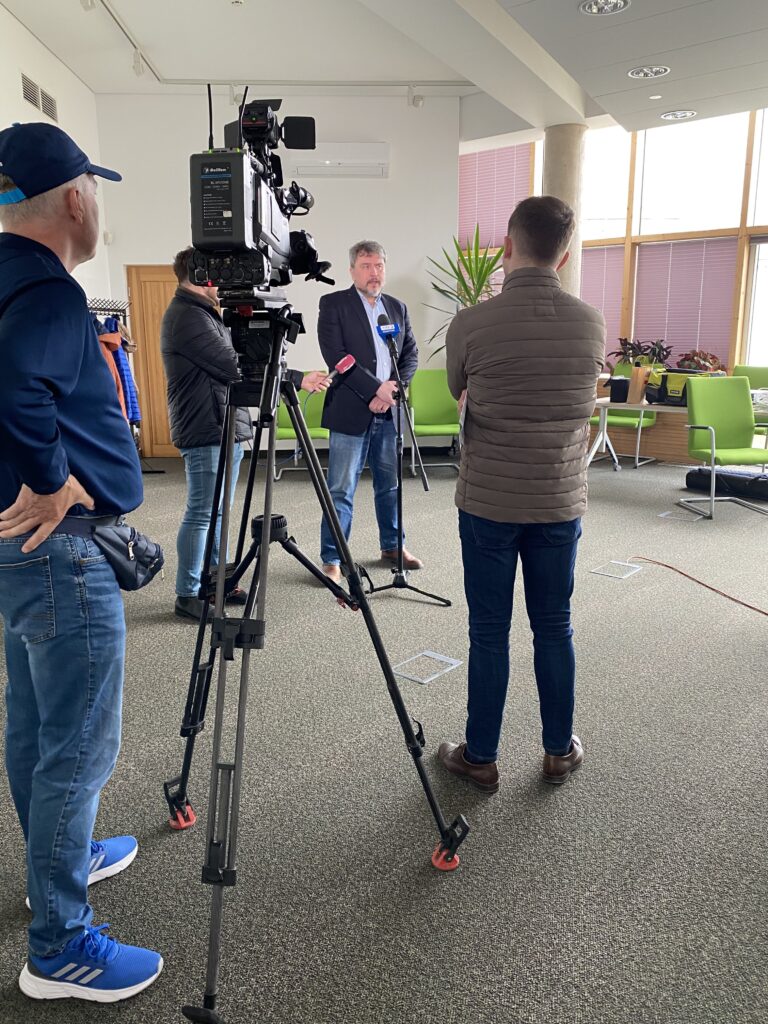
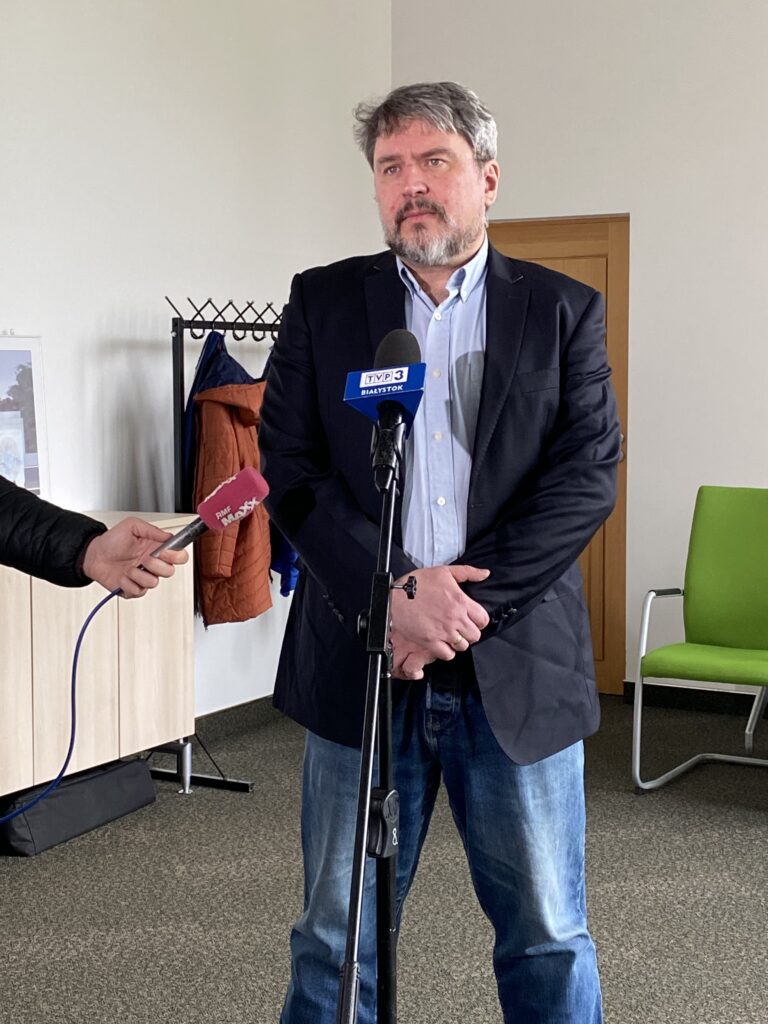
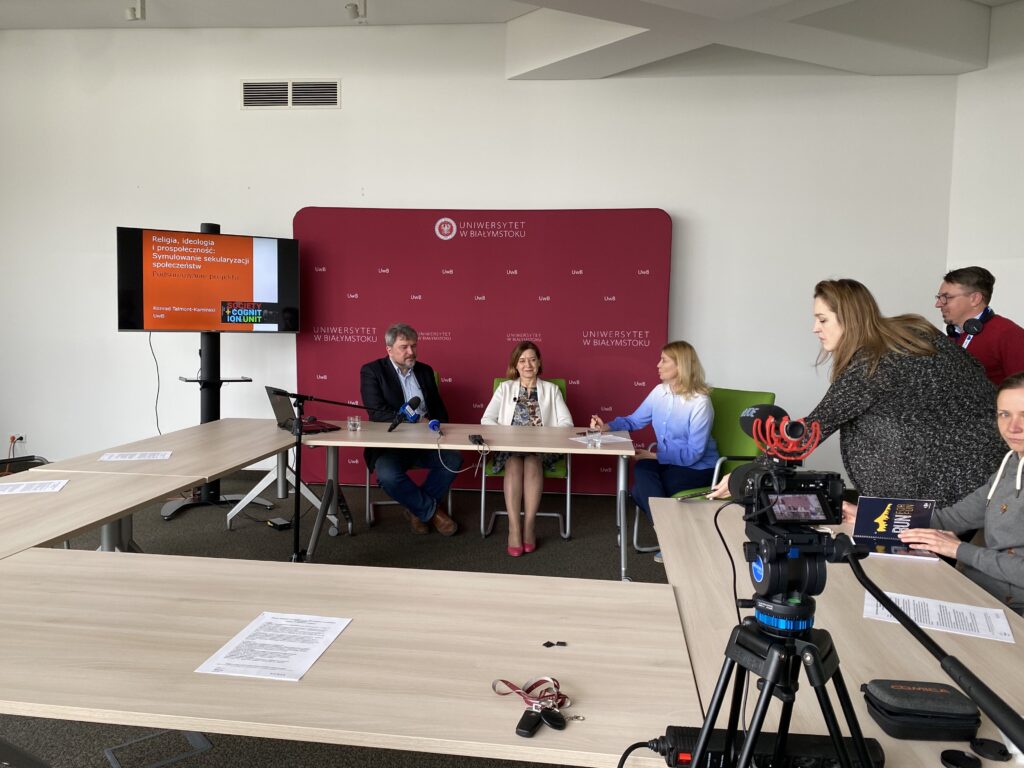
On April 16th, 2024 in Białystok, Poland, was held a official press conference summarizing the project, where the key research findings were presented by the project Principal Investigator – Konrad Talmont-Kamiński.
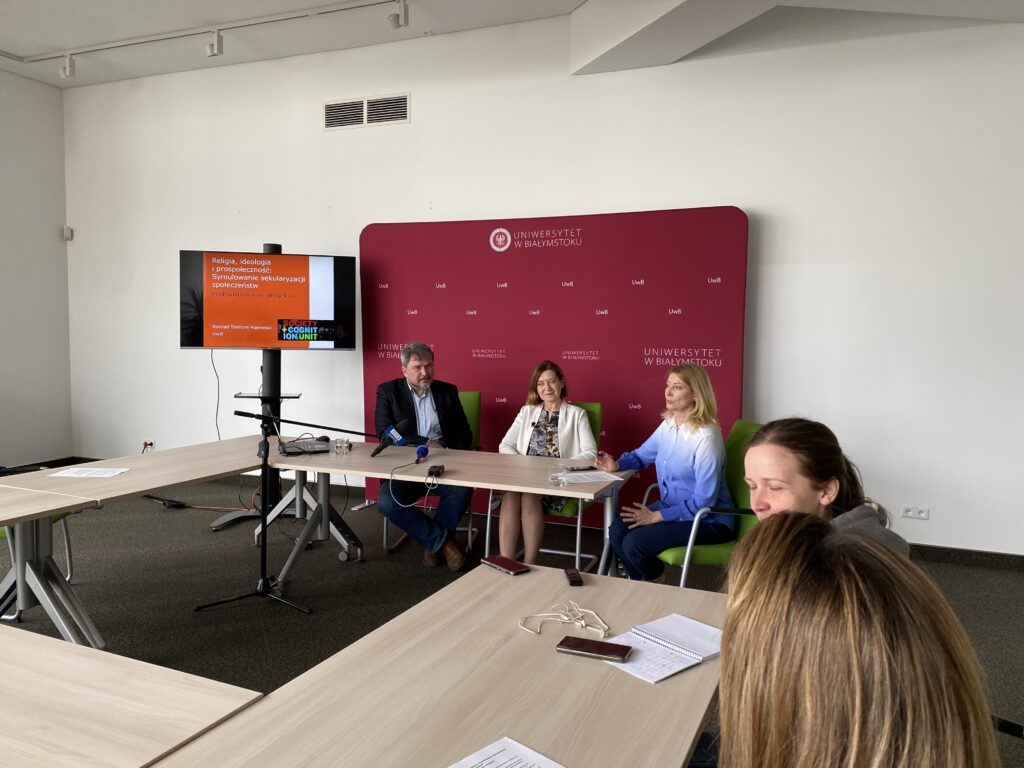
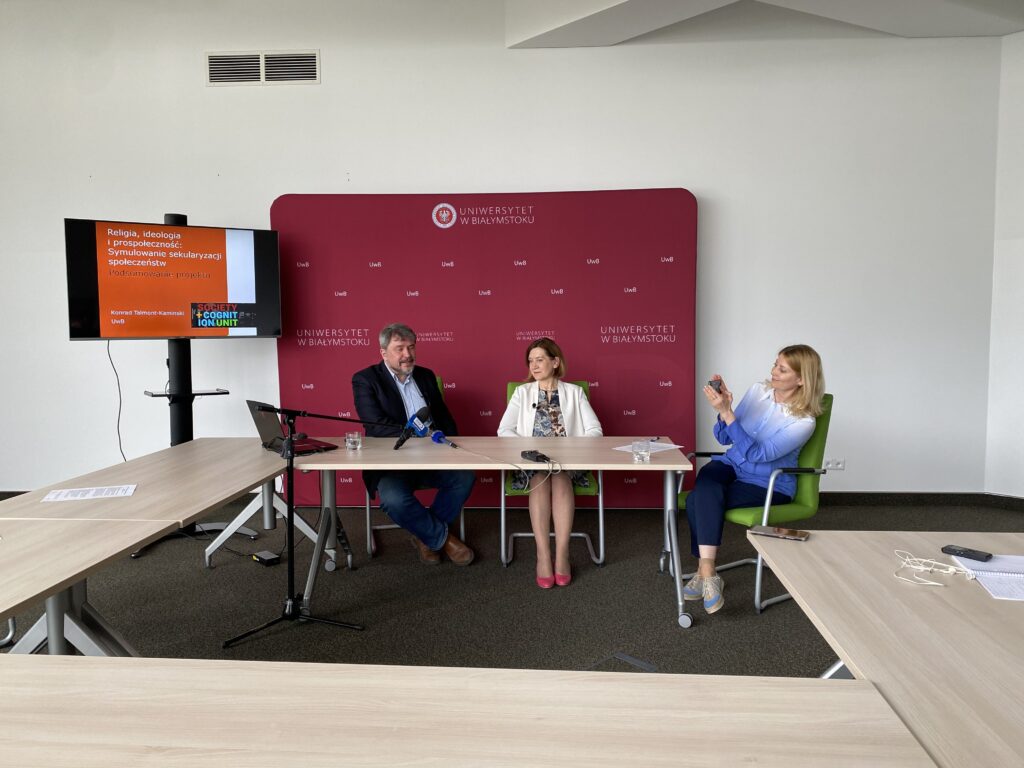

Yes, we work in an international team, so we work mostly online. We meet fortnightly in working groups assigned to one of the four project areas: Fuzzy Fidelity, Prosocial Equilibrium, Epistemic Vigilance and Error Management. On a daily basis we keep in touch using Slack being our main communication tool but we all know how important is to meet in person from time to time. Apart from that who could resist to talk about computer modelling with other geeks all nights long. This is why every year we tried to organise at least three meetings – two visits (in Norway and in Poland) and one seminar in the Metochi study center.


Project seminars in Metochi
We met there three times. First at the beginning of July 2021, then in May 2022 and May 2023. These meetings were a great opportunity for a long discussions about conceptualising and clarify theoretical assumptions for the models as well as academic papers writing.
The meetings were taking place in the Metochi study center. The venue is an annex of the monastery, belonging to the monastery in Limonos. The research center is located on the Greek island of Lesbos and since 1993 it belongs to the Norwegian University of Agder.
NORCE partners visits in Białystok
In mid-October 2021, our Norwegian partners finally had the opportunity to visit Podlasie. The meeting took place in Suprasl, near Bialystok. The monastery walls, the quiet surroundings and the Polish golden autumn were conducive to lengthy discussions on the progress of the fuzzy fidelity model and the conceptualisation of the research needed for the epistemic vigilance model.
Then they visited us two more times: in mid-October 2022 and at the end of September 2023. Having the entire Polish team on hand it was extremely convenient to process research tasks and plan the next one.


Polish team visits in Kristiansand
Polish team was equally keen to visit the Norwegian partners, based in Kristiansand in southern Norway. These three meetings was especially useful in terms of paper writing, testing created models, improving modelling skills and networking. Visits took place in December 2021, April 2022 and March 2023.
The RIP project is planned to involve the use of several different research methodologies to investigate secularisation. On the one hand they involve computer modelling techniques. On the other, a range of empirical (including experimental) methods from a range of disciplines. Both function in feedback with theoretical considerations that must also be pursued for the overall project to succeed.
The computer modelling will involve both systems dynamics models as well as agent based models. Systems dynamics will be used to create models of individuals, reflecting aspects of human cognitive systems that are deemed to be of relevance to the aspect of secularisation under investigation. The agents constructed in this way will then be combined into agent-based models of societies. The interactions between the thousands of agents in these models will make it possible to trace how the psychological and the social processes are connected. Rerunning the simulation thousands of times makes it possible to build up a probabilistic picture of the likely outcomes of the starting conditions. This gives the approach unprecedented predictive strength as well as offering the opportunity for providing insight into the phenomenon by making it possible to track how altering the starting conditions affect outcomes.
The construction of the models relies upon accurate information about the systems to be modelled. In part this information comes from existing sociological, psychological and cognitive studies. However, these studies need not reflect the theoretical assumptions of the planned models nor adequately measure the relevant variables. For this reason, the project also involves: new analyses of existing quantitative sociological data; novel surveys of representative population samples; and a range of experimental studies involving purpose-built methods and designed to explore and modify aspects of the theoretical assumptions underlying the proposed cognitive and psychological models.
The theoretical aspects of the project draw largely upon the work of the PI (especially the theoretical model presented in Religion as a Magical Ideology), as well as the work of the broader community of researchers that have been investigating secularisation in the last few decades, particularly those working within quantitative sociology of religion and cognitive science of religion. As such, the theoretical aspects are aimed to draw out the implications of the idea that religions combine the traits of ideologies – belief systems which function to motivate parochial prosociality – with magical systems of beliefs and practices that find their basis in the cognitive biases that all humans share; with the rationale for the conjunction of these aspects being the way in which religions make use of and modify people’s natural reasoning.
To pursue the many avenues that need to be explored for the good of this interdisciplinary project, a team with a wide range of disciplinary backgrounds is necessary. The Principal Investigator, Konrad Talmont-Kaminski, comes to the issues with a background in the philosophy of science and years of experience in the study of the evolutionary and cognitive basis of human social behaviours such as religion, providing him with a broad theoretical overview of the issues involved in secularisation. The Polish team also includes a cognitive psychologist, Paweł Łowicki, with experience in the planning and execution of experimental studies into the psychological mechanisms underpinning religious practices and beliefs, as well as a quantitative sociologist, Łukasz Kiszkiel, who has the skills necessary to gather and interpret the sociological data the project calls for. In addition, the team in Białystok will be rounded out by two modellers in post-doctoral positions who will be responsible for developing computer models of some of the aspects of secularisation that will be investigated and two students in receipt of doctoral scholarship who will pursue thesis topics closely connected to the overall project as well as participating in the variety of research activities the project involves. The Norwegian team is made up of LeRon Shults, who has studied theology and philosophy but has spent the last few years focussing on using computer models to understand social processes, and Ivan Puga Gonzalez, whose experience in constructing such models will provide the practical and methodological basis for much of the modelling work that will be done as part of the RIP project.


In addition, the project will draw upon the experience of other researchers including David Voas, Neil Levy, Wesley Wildman and Ross Gore.


For the purposes of the RIP project, Bialystok University is purchasing a computer system that will be powerful enough to carry out the millions of calculations that the complex models used by the project require and which will be located within the university’s computation centre. Appropriately enough, the system will be called Thor. Though the Polish members of the team might sometimes refer to it as Perun.

Every project is only a step in the ongoing scientific endeavour to understand ourselves and the world we live in. It is the intention of the project leaders that RIP will not only further our understanding of secularisation but will constitute the foundation for long-term cooperation between the Polish and Norwegian sides as well as a key step in the development in Bialystok of an internationally renowned research centre into the cognitive basis of social processes, for which the use of computer modelling methods will be a standard tool.